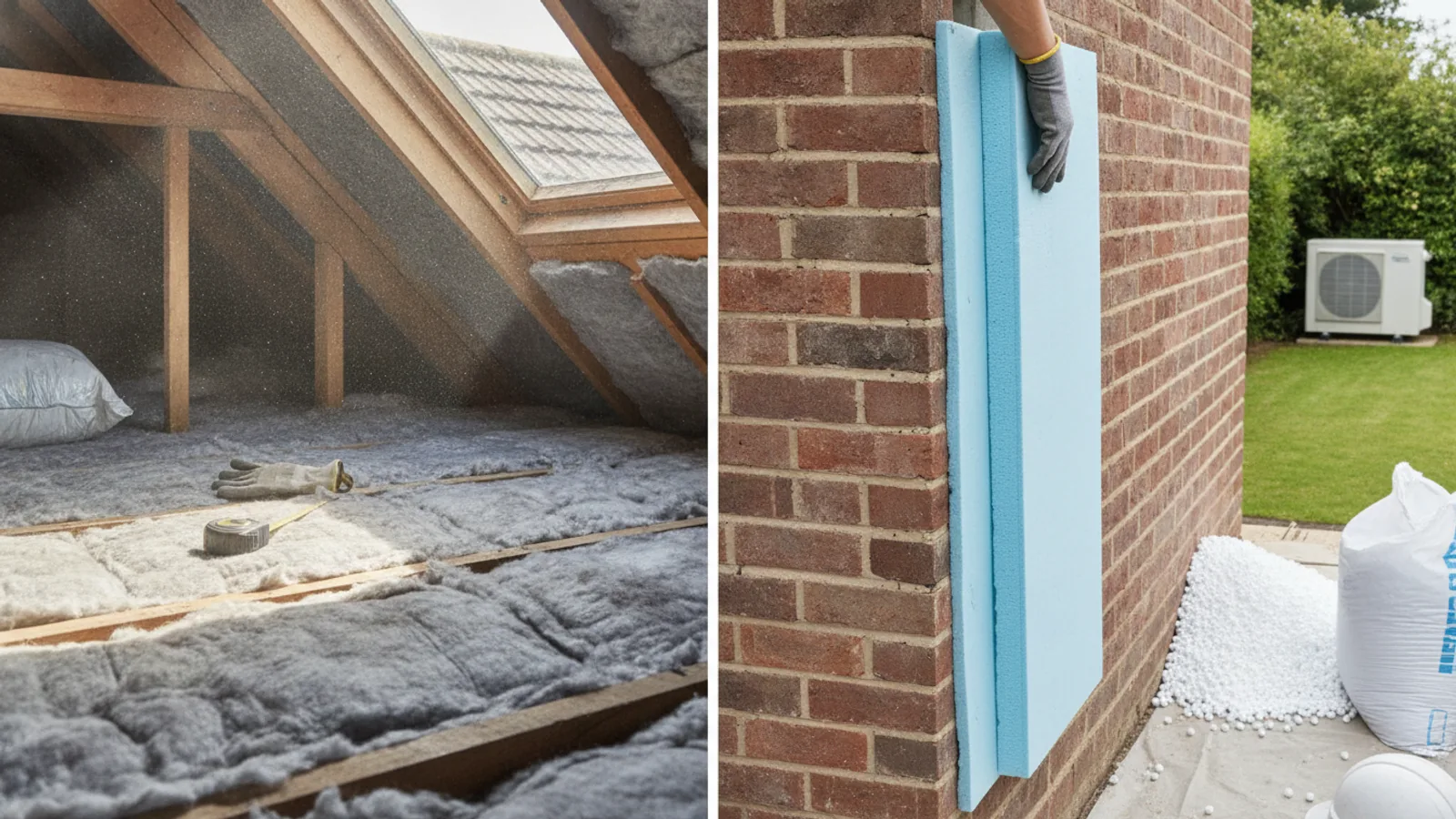
Loft Insulation vs Cavity Wall Insulation: Which Should You Choose?
Head-to-head comparison
Overall winner: Loft Insulation for its unmatched cost-effectiveness and rapid return on investment.
For most UK homeowners looking for the single most impactful and affordable energy-saving upgrade, loft insulation is the clear first choice. It's often a straightforward DIY job with a payback period of just a few years. Cavity wall insulation is a crucial, high-impact measure for homes built between the 1920s and 1990s, but it's a bigger upfront investment that requires professional installation. Ideally, a truly energy-efficient home will have both.
Option A
Loft Insulation
- Best for first-time insulation projects
- Fastest payback period
- Often a DIY-friendly installation
Option B
Cavity Wall Insulation
- Best for tackling the largest area of heat loss
- Essential for suitable properties
- Zero disruption inside the home
Head-to-Head Scorecard
Loft Insulation vs Cavity Wall Insulation: Key Differences
While both serve the same ultimate goal—trapping heat inside your home—their methods and implications are fundamentally different. Understanding these distinctions is key to making the right choice.
- Location and Heat Loss: Loft insulation is installed in the floor of your attic, stopping heat from rising out of your living spaces and escaping through the roof. Cavity wall insulation is pumped into the gap (the 'cavity') between the inner and outer layers of brickwork on your home's external walls, creating a thermal barrier around the entire property.
- Installation Method: Loft insulation, typically sold in rolls of mineral wool, can be laid down by a confident DIYer. It involves clearing the loft, rolling out the insulation between and over the joists, and ensuring no gaps are left. Cavity wall insulation is a professional-only job. Certified technicians drill a series of small holes in the mortar of your exterior walls and use specialist equipment to blow insulating material into the cavity.
- Property Suitability: Almost every house with a loft can benefit from loft insulation. Cavity wall insulation is only suitable for homes built with a cavity, which generally means properties constructed between the 1920s and the 1990s. Older solid-wall properties and modern timber-frame homes are not suitable.
- Cost and Return: Loft insulation is one of the most affordable major energy-saving improvements, often costing just a few hundred pounds if you do it yourself. This leads to a very fast payback period, often under three years. Cavity wall insulation costs more—typically over £1,000 for a semi-detached house—and has a slightly longer, but still very attractive, payback period of around five to six years.
Measurement Winners for loft insulation vs cavity wall insulation
Measurement
Installation & Routine Fit
This category assesses the complexity, accessibility, and disruption of the installation process. Loft insulation offers a level of flexibility that cavity wall insulation cannot match. For homeowners on a tight budget or those who enjoy DIY projects, loft insulation is an accessible weekend job. The process involves buying rolls of insulation from a hardware store and laying them in the attic. While it requires care (wearing protective gear is essential) and can be dusty work in a cramped space, it doesn't require specialist skills or equipment.
Cavity wall insulation, by contrast, is strictly a job for certified professionals. The process is highly technical and requires specialist blowing equipment to ensure the cavity is filled completely without voids. The good news is that for the homeowner, the process is very low-effort. A team can typically complete the job in a few hours from the outside of your home with minimal disruption. However, the reliance on professionals means you are subject to their availability and pricing.
Measurement
Thermal Performance & Heat Loss Reduction
Here, we look at the raw effectiveness of each method in preventing heat loss. According to the Energy Saving Trust, uninsulated walls are the single biggest source of heat loss in a typical home, accounting for around 35%. The roof comes in second, responsible for about 25%. On paper, this gives cavity wall insulation a slight edge in its potential to stop more heat from escaping.
A properly insulated cavity creates a complete thermal envelope around your living space. Loft insulation, while preventing the significant "chimney effect" of heat rising directly out, doesn't address the vast surface area of the walls. However, the performance of loft insulation is very reliable. Building regulations recommend a depth of 270mm, which provides a highly effective thermal barrier. The performance of cavity wall insulation depends heavily on the quality of the installation; any gaps or 'slumping' of the material over time can create cold spots and reduce its overall effectiveness.
Measurement
Ease of Use & DIY Friendliness
This metric is about how easily a homeowner can implement the solution. There is no contest here. Loft insulation is one of the most common and impactful DIY projects a homeowner can undertake. The materials are readily available, and the process, while physically demanding, is straightforward. There are countless guides and videos available, and the only real requirements are physical ability to work in a loft and adherence to safety precautions (e.g., dust masks, gloves, crawl boards).
Cavity wall insulation is the polar opposite. It is not, and should never be, a DIY job. Attempting to do so would be ineffective and potentially damaging to your property. It requires a CIGA (Cavity Insulation Guarantee Agency) certified installer to ensure the correct material is used and injected properly to avoid damp issues. For the homeowner, its 'ease of use' is in its hands-off nature—you just have to find a reputable company and book them in.
Measurement
Value & Payback Period
Value is a combination of upfront cost and long-term savings. This is where loft insulation builds an almost unbeatable case as the first-choice investment. The cost to insulate a loft can be as low as £400-£600 for materials if you DIY. Professional installation might bring the total to between £800 and £1,200 for a typical semi-detached house. With annual savings estimated by the Energy Saving Trust to be up to £270, the payback period can be as short as two years for a DIY job.
Cavity wall insulation offers greater total savings—up to £395 per year for a semi-detached house. However, the upfront cost is significantly higher, typically ranging from £1,500 to £2,500. This results in a longer payback period, usually around 5-7 years. While still an excellent investment, it doesn't offer the rapid return that makes loft insulation so compelling, especially for those with a limited initial budget. Government grants, like the Great British Insulation Scheme, can sometimes reduce the cost of both, but loft insulation's inherent affordability gives it the edge.
Measurement
Buyer Confidence & Long-Term Risks
Confidence in an investment comes from its reliability and low risk of future problems. Loft insulation is a very low-risk intervention. The materials (like mineral or fibreglass wool) are inert, stable, and have been used for decades. The main risks are related to installation—blocking ventilation at the eaves (which can cause condensation) or compressing the insulation (which reduces its effectiveness). These are easily avoided with careful installation.
Cavity wall insulation, while safe and effective when done correctly on a suitable property, has a more troubled history. In the past, poor installations or its application to unsuitable homes (e.g., those in areas with wind-driven rain) led to serious problems with damp and mould. Modern survey techniques and accredited installer schemes have massively reduced these risks, and a CIGA guarantee offers a 25-year warranty. However, the potential for serious issues if things go wrong means homeowners must be extra diligent in choosing a reputable installer and ensuring their property is suitable, which adds a layer of anxiety not present with loft insulation.
Choose Loft Insulation If...
- Your budget is tight: It's the most affordable, high-impact energy efficiency measure you can buy.
- You want the fastest return on investment: You'll start seeing a net financial gain in as little as two to three years.
- You're comfortable with DIY: You can save a significant amount on labour costs by installing it yourself over a weekend.
- Your home has an accessible loft space: If you can get into your loft and it's not already filled with belongings, you're a prime candidate.
- You are starting your home efficiency journey: This is universally considered the best "first step" to take before any other insulation project.
Choose Cavity Wall Insulation If...
- Your loft is already insulated to the recommended 270mm: This is the logical and most impactful next step. _
- Your house was built between the 1920s and 1990s: These properties are most likely to have uninsulated cavity walls suitable for filling.
- You want to tackle the largest single source of heat loss: Walls account for more heat loss than the roof.
- You want zero internal disruption: The entire process is handled from outside your home.
- You have confirmed your property is suitable: A professional survey has confirmed your brickwork is in good condition and your location is not at high risk of wind-driven rain.
Final Verdict: Loft Insulation vs Cavity Wall Insulation
While a fully optimised home should have both, the question is which to prioritise. Our analysis points to a clear winner for the vast majority of homeowners: Loft Insulation.
Its unbeatable combination of low cost, high impact, and rapid payback period makes it the most logical and financially sensible first investment in home energy efficiency. The ability to install it yourself further enhances its value proposition, putting significant energy savings within reach for a modest upfront cost. It's a low-risk, high-reward project that delivers immediate comfort and long-term savings.
Cavity Wall Insulation is an incredibly important and effective measure, but it serves better as the second step in your insulation journey. It tackles a larger area of heat loss and offers slightly higher annual savings, but its higher cost, longer payback period, and the absolute requirement for professional installation place it behind the straightforward efficiency of insulating your loft. If your loft is already up to standard, then cavity wall insulation should be at the very top of your list.
Loft Insulation vs Cavity Wall Insulation: Which Should You Choose? FAQ
Do I need both loft and cavity wall insulation?
Ideally, yes. For a house to be truly energy-efficient, it needs a complete thermal envelope. Insulating just one area leaves the other as a major source of heat loss. The best strategy is to insulate the loft first due to its low cost and fast payback, then save for and install cavity wall insulation as the next step.
Are there any grants available in the UK for insulation in 2026?
Yes, government schemes are often available to help with the cost of insulation. The primary one is often the Great British Insulation Scheme (formerly ECO+), which provides grants to households based on their council tax band or if they receive certain benefits. These grants can significantly reduce or even cover the entire cost of professional installation for both loft and cavity wall insulation. It's essential to check the official government website or Ofgem for the latest eligibility criteria.
Can cavity wall insulation cause damp?
If installed incorrectly or in an unsuitable property, yes, it can. The insulation can form a 'bridge' for moisture to cross the cavity from the outer to the inner wall. This risk is why it's crucial to use a CIGA-guaranteed installer who will perform a thorough survey beforehand to check your property's suitability, wall condition, and local weather exposure.
How do I know if I have cavity walls?
Look at the brickwork on your external walls. If the bricks are all laid lengthways in a repeating pattern (stretcher bond), you likely have cavity walls. If you see a pattern with the ends of bricks mixed in (Flemish or English bond), you likely have solid walls. Another clue is wall thickness; cavity walls are generally more than 260mm (10 inches) thick. If in doubt, a professional can check with a small camera called a borescope.
How much money can I really save?
Savings depend on your house type, existing insulation, and energy usage. Based on Energy Saving Trust figures for a typical three-bedroom semi-detached gas-heated home, topping up loft insulation from 120mm to 270mm could save around £270 per year. Installing cavity wall insulation in a previously uninsulated home could save up to £395 per year. These are significant savings that make both excellent long-term investments.


