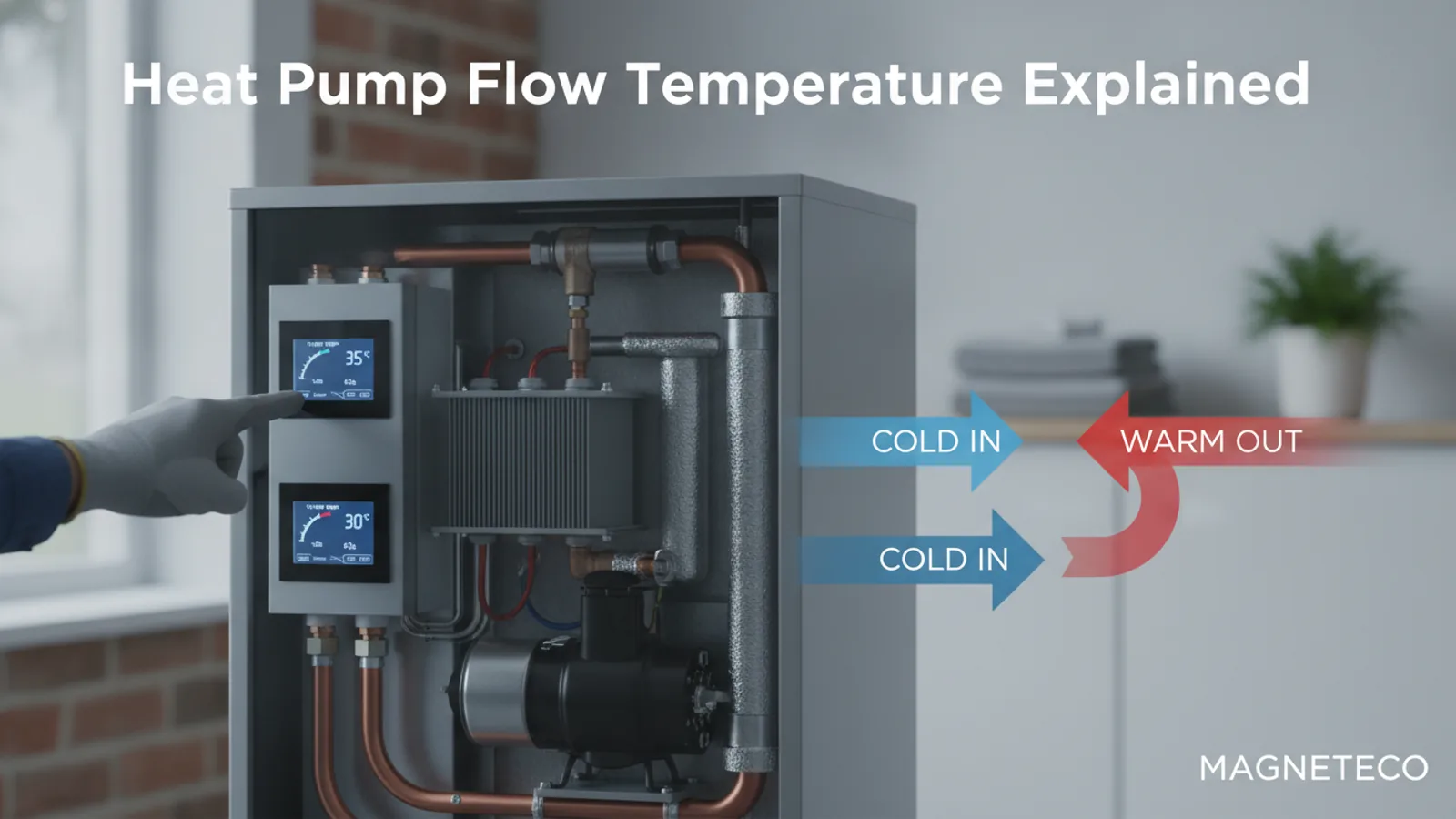
Heat Pump Flow Temperature Explained
Understanding your heat pump's flow temperature is the single most important step to unlocking lower running costs and better home comfort. This guide explains what flow temperature is, how it affects your electricity bills, and how to check and optimise it for your specific home. Getting this setting right ensures your heat pump runs at peak efficiency, saving you money and energy without sacrificing warmth.
Fast Answer
- Ideal Flow Temperature: 35°C to 50°C
- Key Principle: The lower the flow temperature, the higher the efficiency and the lower your running costs.
- Weather Compensation: Your heat pump should automatically adjust this temperature based on how cold it is outside.
Before You Start
- Your heat pump's user manual: Every system's control panel and terminology is slightly different. Keep the manual handy to find the right menus.
- Access to your main controller: You will need to navigate the menus on your indoor unit or main thermostat.
- Patience: The key to optimisation is making small changes and waiting. Drastic adjustments can lead to discomfort or inefficiency.
- A note of the outside temperature: This helps you understand if the current flow temperature makes sense for the weather conditions.
Step-by-Step Instructions
Understand the 'Flow' in Flow Temperature
Before touching any settings, it's vital to know what you're looking at. "Flow temperature" is the temperature of the water as it leaves your heat pump to travel around your home's heating system (your radiators or underfloor heating pipes). Think of it as the heat pump's output temperature for your central heating.
This heated water flows through the pipes, releases its warmth into your rooms, and then travels back to the heat pump at a cooler temperature. This returning water is called the "return temperature." The difference between the two is key. A heat pump works most efficiently when the difference between the outside air temperature and the flow temperature it needs to produce is as small as possible.
Unlike a gas boiler that blasts water out at 60-80°C, a heat pump sips energy to produce water at a much lower temperature, typically 35-50°C. It's designed to provide a constant, gentle warmth rather than short, hot bursts. This is the fundamental difference you need to embrace for efficient operation.
Locate the Flow Temperature Setting on Your Controller
Now, let's find the setting. You'll need to use your indoor control panel or wall-mounted thermostat. Because manufacturers use different terms, this is where your user manual is essential.
Navigate through the menu and look for terms like:
- Flow Temperature or Set Flow Temperature
- Weather Compensation Curve or Heating Curve
- Water Temperature (ensure this is for heating, not Domestic Hot Water - DHW)
- Design Temperature
Most modern systems don't have a single, fixed flow temperature. Instead, they use "weather compensation." This is a smart feature that automatically adjusts the flow temperature based on the temperature outside. The settings for this are often visualised as a graph or "curve." Don't be intimidated by this; the principle is simple. When it's colder outside, the system automatically increases the flow temperature. When it's milder, it lowers it to save energy.
Assess Your Home's Heat Emitters
The right flow temperature for your home depends heavily on what is releasing the heat into your rooms. These are your "heat emitters," and they fall into two main categories.
- Underfloor Heating (UFH): This is the ideal partner for a heat pump. Because UFH covers a huge surface area, it can effectively heat a room with very low water temperatures, typically in the 35-40°C range. If you have UFH, your flow temperature should be set nice and low.
- Radiators: The size of your radiators is critical. Standard-sized radiators, designed for old gas boilers, have a small surface area and may require a higher flow temperature (e.g., 45-55°C) to adequately heat a room. However, homes that have been properly retrofitted for a heat pump will have larger, "oversized" radiators. These have a much bigger surface area, allowing them to work effectively with a lower flow temperature, closer to 40-45°C.
Check your radiators. Are they standard single-panel models, or are they larger K2 (double panel, double convector) or K3 types? The bigger, the better, and the lower you can set your flow temperature.
Evaluate Your Home's Insulation Level
Your home's ability to retain heat is the second major factor influencing your ideal flow temperature. A well-insulated, airtight home loses heat very slowly. This means the heating system only needs to gently top up the warmth, which can be done with a very low and constant flow temperature.
Conversely, a draughty home with poor insulation in the loft or walls will lose heat quickly. To feel warm, you might be forced to run a higher flow temperature to compensate for the rapid heat loss. This makes the heat pump work harder and less efficiently, increasing your bills.
If your flow temperature needs to be above 50°C to keep your home warm, it's often a sign that your home's insulation, not the heat pump, is the primary issue. Improving loft insulation, cavity wall insulation, and draught-proofing can allow you to lower the flow temperature and make significant savings.
Understand Your Weather Compensation Curve
If your system uses weather compensation, you won't set a single temperature. Instead, you'll adjust the "heating curve." This curve tells the heat pump exactly what flow temperature to produce for any given outside temperature.
For example, the curve might be set to:
- Deliver 45°C flow when it's -2°C outside.
- Deliver 35°C flow when it's 10°C outside.
The controller then calculates all the points in between. Adjusting this curve is the key to optimisation. Most systems allow you to "shift" the whole curve up or down. If your house is consistently a little too cool, you might shift the curve up by 1 or 2 degrees. If it's too warm, you'd shift it down. This simple adjustment ensures you are only ever using the precise amount of energy needed, whatever the weather.
Make Small, Incremental Adjustments
The golden rule of heat pump optimisation is: change one small thing at a time. Heat pump systems and modern homes have a lot of thermal mass, meaning they heat up and cool down slowly. You will not feel the effect of a change immediately.
If you feel your home is slightly too cool or you suspect the flow temperature is unnecessarily high, adjust your heating curve or target temperature downwards by just 1°C or 2°C. Do not make a big jump from 50°C down to 40°C.
After making a small adjustment, leave the system alone for at least 24 hours. This gives the house time to settle at the new temperature and allows you to accurately judge whether the change has affected your comfort level. Keep a log of your changes and the corresponding outdoor temperatures to see what works best.
Differentiate from Domestic Hot Water (DHW) Temperature
It's crucial not to confuse the central heating flow temperature with the temperature for your hot water cylinder. Your domestic hot water (DHW) needs to be stored at a higher temperature, typically 50-60°C, to prevent the growth of harmful bacteria like Legionella.
Your heat pump knows this and has a completely separate setting for DHW. It will pause its heating duties periodically and run at a higher, less efficient temperature for a short period to heat your water cylinder. This is normal. When you are adjusting your heating settings, make sure you are in the "space heating" menu, not the "DHW" or "tank" menu.
Quick Reference
| Situation | Typical Flow Temperature Range | Why |
|---|---|---|
| Mild Autumn/Spring Day (10°C outside) | 35°C - 40°C | Minimal heating is needed; the system runs at its most efficient. |
| Cold Winter Day (0°C outside) | 40°C - 48°C | A higher temperature is needed to counteract greater heat loss from the house. |
| Home has underfloor heating (UFH) | 35°C - 40°C | The large surface area of UFH is highly effective at radiating heat, even at low water temperatures. |
| Home has oversized radiators | 40°C - 45°C | Larger radiators have more surface area, allowing them to heat the room with cooler water. |
| Home has standard radiators | 45°C - 55°C | Smaller surface area requires hotter water to produce the same amount of heat. This is less efficient. |
Common Problems When Optimising Flow Temperature
- The house feels too cold. This is the most common concern. The cause is often a flow temperature set too low for the building's heat loss on a given day. First, resist the urge to immediately turn it up. Ensure all your internal doors are closed and wait a few hours. If it's still cold, increase the flow temperature setting by only 1-2°C. Remember, heat pumps provide a constant background heat, not a quick blast of warmth.
- Electricity bills are still high. If your bills are high, your flow temperature is the first place to look. A setting of 55°C can use significantly more electricity than one of 45°C. The goal is to find the lowest possible temperature that maintains comfort. If you can't get it below 50°C without feeling cold, the next step is to investigate insulation and draught-proofing improvements.
- Radiators are only lukewarm to the touch. This is usually a sign of a well-running system! Unlike boiler radiators that can be too hot to touch, heat pump radiators are designed to be gently warm for long periods. If the room is at a comfortable temperature, then the system is working perfectly.
- The heat pump is "cycling" on and off frequently. This can happen if the flow temperature is set too high. The system quickly heats the water, satisfies the thermostats, and shuts off. A few minutes later, it has to start up again. This stop-start cycle is inefficient. Lowering the flow temperature encourages longer, more gentle, and more efficient run times.
Advanced Tips for Heat Pump Flow Temperature
- Fine-Tune Your Heating Curve: Beyond just shifting the curve up or down, most controllers allow you to change its "slope" or "gradient." A steeper slope means the flow temperature will increase more dramatically as the outside temperature drops. A shallower slope is for well-insulated homes that need less of a boost in cold weather. Small adjustments here can perfect your system's automatic response.
- Check Radiator Balancing: If some rooms are warm while others are cold, your radiators may be "unbalanced," with too much hot water flowing to the first few in the circuit. Balancing involves adjusting the lockshield valves on each radiator to ensure an even distribution of heat. A balanced system allows you to run a lower overall flow temperature.
- Review Thermostat Placement: Your main thermostat tells the heat pump when the desired room temperature is reached. If it's in a cold hallway or a sunny conservatory, it will give false readings, causing the system to run incorrectly. Ensure it's placed in a primary living area, away from draughts and direct heat sources.
- Set Back, Don't Switch Off: It is almost always more efficient to lower the thermostat by 2-3°C overnight than to turn the system off completely. This prevents the building from getting truly cold, avoiding the energy-intensive process of a full reheat the next morning. It allows the heat pump to keep ticking over at its most efficient low level.
Heat Pump Flow Temperature Explained FAQ
What is the best flow temperature for a UK heat pump?
There is no single "best" temperature; it's the lowest temperature that keeps your unique home comfortable. However, a great target for a well-designed system is between 35°C and 45°C. If you need to consistently run above 50°C, it's worth investigating your insulation or radiator sizes to improve overall efficiency.
Is 55°C too high for a heat pump flow temperature?
While most modern heat pumps can achieve 55°C, it is considered high and will significantly reduce the unit's efficiency (its CoP, or Coefficient of Performance). Running at this temperature is sometimes necessary for older systems with small radiators, but it negates many of the cost-saving benefits. It should be seen as a temporary measure or a sign that other upgrades are needed.
Why are my heat pump radiators not very hot?
This is by design. Heat pumps are most efficient when they gently heat water to a lukewarm temperature (e.g., 40°C) and circulate it continuously. This provides a steady, even warmth. Radiators from a gas boiler get very hot (60-75°C) because they operate in short, powerful bursts. If your room is warm and comfortable, lukewarm radiators mean your system is working efficiently.
What is the difference between flow and return temperature?
Flow temperature is the water temperature leaving the heat pump. Return temperature is the water temperature coming back to the heat pump after circulating through your radiators or UFH. The difference between them is called the "Delta T". For radiators, a Delta T of 5-10°C is typical. For UFH, it's usually smaller, around 3-5°C.
Final Checklist for Heat Pump Flow Temperature
- You have located your heat pump's user manual for reference.
- You can find the "flow temperature" or "heating curve" settings on your main controller.
- You have identified your type of heat emitters (underfloor heating or radiator size).
- You understand that a lower flow temperature equals higher efficiency and lower costs.
- When making adjustments, you change the setting by only 1-2°C at a time.
- You wait at least 24 hours to properly assess the impact on your home's comfort after a change.
- You have confirmed the lowest possible flow temperature that keeps your home warm across different weather conditions.


