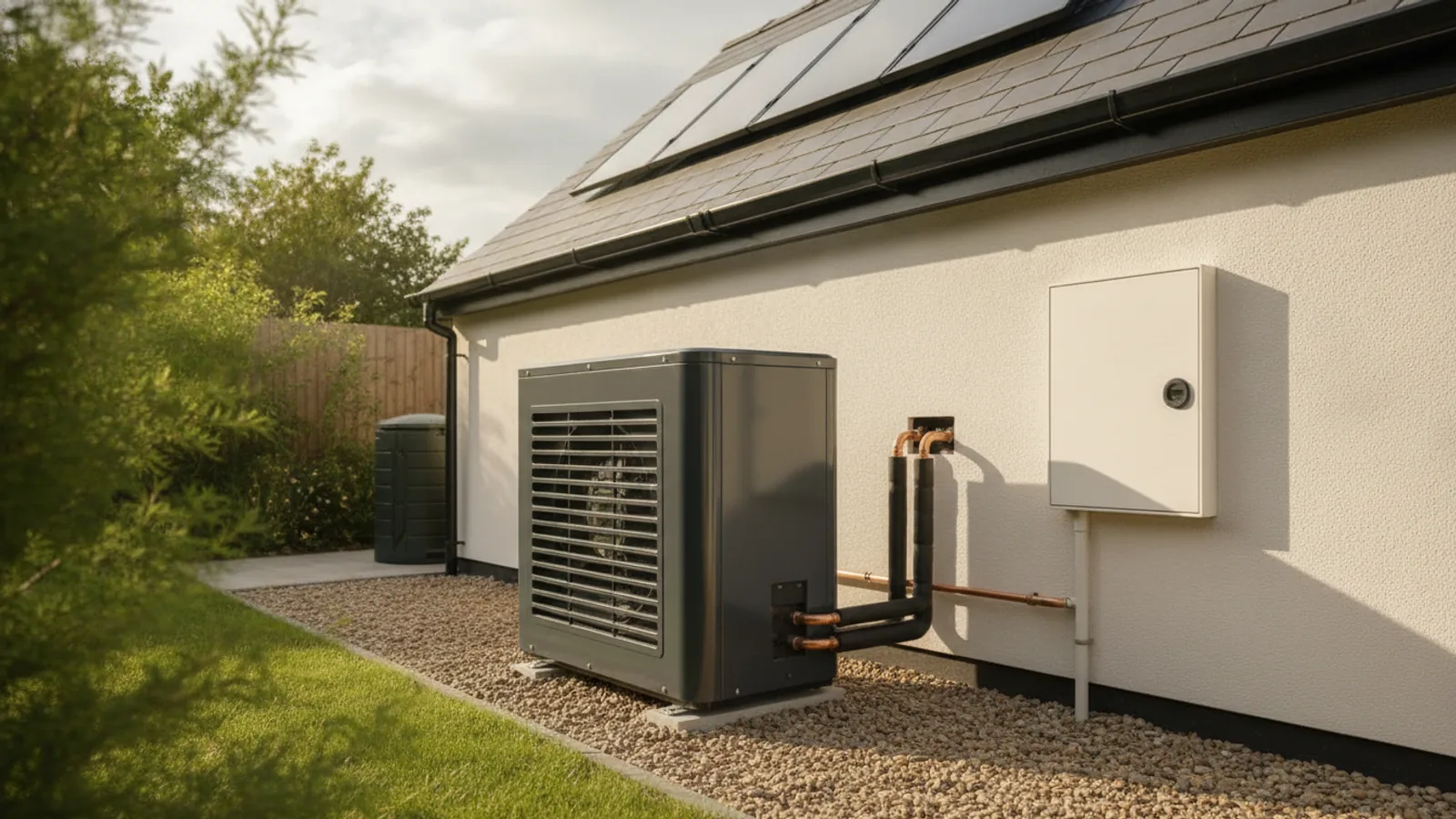
Air Source Heat Pump Basics
An air source heat pump is a modern, highly efficient alternative to a traditional gas or oil boiler. Instead of burning fuel, it cleverly moves existing heat from the outside air into your home. This guide explains the fundamental principles of how they work, helps you assess if your home is suitable, and walks you through the key considerations before you talk to an installer. Understanding these basics is the first step towards a lower-carbon home and potentially lower heating bills.
Fast Answer
- Key principle: Moves heat from the outside air to inside your home, even in cold weather.
- Best for: Well-insulated homes with underfloor heating or oversized radiators.
- Main benefit: 3-4 times more efficient than boilers, reducing carbon emissions and energy use.
- Main requirement: Requires a certified professional for design and installation. This is not a DIY job.
Before You Start
Before diving into quotes and installation details, it’s vital to understand the groundwork. An air source heat pump (ASHP) is a significant investment that works best when the surrounding conditions are right. This preparation phase is about assessing your home, not the heat pump itself.
What You Need
- Your home's Energy Performance Certificate (EPC): This gives you a snapshot of your property's insulation levels. An EPC rating of 'C' or higher is ideal.
- Recent energy bills: Knowing your annual energy consumption in kilowatt-hours (kWh) for heating helps estimate potential running costs.
- A tape measure: Useful for a quick check of your radiator sizes and the potential outdoor space for the unit.
- An internet connection: For researching government grants like the Boiler Upgrade Scheme and finding local certified installers.
Safety, Timing, or Context Checks
- Installation is for professionals only: An ASHP system must be designed and fitted by a Microgeneration Certification Scheme (MCS) certified installer. This is crucial for safety, efficiency, and eligibility for government grants.
- Insulation is non-negotiable: The single biggest factor for success is how well your home retains heat. Without sufficient loft, cavity wall, and floor insulation, a heat pump will struggle and cost a fortune to run.
- Check for grants first: In the UK, significant government grants are often available. Check the current status of the Boiler Upgrade Scheme (BUS) in England and Wales, or equivalent schemes in Scotland and Northern Ireland, before you commit to any work.
Step-by-Step Instructions
This "how-to" guides you through the process of understanding and evaluating if an air source heat pump is the right choice for your home. It's a journey of assessment, not a guide to physical installation.
Understand How a Heat Pump Actually Works
Forget everything you know about creating heat by burning something. A heat pump works more like a refrigerator in reverse. It doesn't create heat; it moves it.
The system has two main parts: an outdoor unit and an indoor unit. Here’s the simple version:
- The outdoor unit has a fan that draws in outside air, passing it over a coil filled with a special refrigerant fluid.
- This refrigerant has a very low boiling point. It absorbs latent heat from the air, even on a cold day, and turns into a gas.
- This gas is then passed through a compressor, which squeezes it. Just like a bicycle pump gets hot when you use it, compressing the gas dramatically increases its temperature.
- The hot, high-pressure gas then travels to the indoor unit (or a heat exchanger inside your hot water cylinder). It passes its heat to your central heating water, which is then pumped to your radiators or underfloor heating.
- Having lost its heat, the refrigerant condenses back into a cool liquid and flows back to the outdoor unit to start the cycle again.
This cycle is incredibly efficient. For every 1 unit of electricity the heat pump uses to run the compressor and fan, it can harvest 3 to 4 units of heat from the air. This efficiency rating is called the Coefficient of Performance (CoP).
Assess Your Home’s Suitability
A heat pump is only as good as the home it's installed in. This step is a critical reality check.
Insulation: As mentioned, this is paramount. Your EPC report is the best place to start. If it's rated D or below, the report will include recommendations for improvements. Prioritise these first. A well-insulated home needs less heat, allowing the ASHP to run efficiently at a lower, steadier rate.
Radiators or Underfloor Heating: Heat pumps produce hot water at a lower temperature (typically 35-55°C) compared to a gas boiler (which can be 60-80°C). To get the same amount of warmth into a room with cooler water, you need a larger surface area. Underfloor heating is perfect for this. If you have radiators, you might need to replace them with larger models (e.g., K2 or K3 types, which have more fins and panels). A quick check is to see if your current radiators are single panels; if so, they will likely need upgrading.
Space Requirements: You'll need a suitable spot for the outdoor unit. It must be on a solid base, with several feet of clear space around it for airflow, and ideally not right under a bedroom window due to fan noise. Inside, you will need a large hot water cylinder, as heat pumps are not "combi" systems that heat water on demand. You'll need space for a cylinder that's big enough to store a full day's worth of hot water.
Estimate Potential Running Costs and Savings
This requires some careful, honest calculation. While a heat pump is very efficient, the cost of electricity per unit (kWh) in the UK is much higher than the cost of gas.
First, find your annual heating demand in kWh from your gas bill. Let's say it's 12,000 kWh. To find out how much electricity a heat pump would use, you divide this by its seasonal efficiency, or SCOP (Seasonal Coefficient of Performance). A typical SCOP in the UK is around 3.
Calculation Example:
12,000 kWh (gas demand) ÷ 3 (SCOP) = 4,000 kWh (electricity needed)
Now, multiply that by your electricity price per kWh. Compare this to what you paid for 12,000 kWh of gas. This will give you a rough idea of running costs. Remember to factor in the savings from no longer paying the gas standing charge. Savings are not guaranteed and depend heavily on your home's insulation, system design, and how you use it.
Learn to "Drive" a Heat Pump Correctly
You cannot operate a heat pump like a gas boiler. A boiler is like a drag racer: it fires up fast, gets very hot, and then switches off. A heat pump is like a long-distance lorry: it performs best when it gets up to a steady speed and just keeps going.
The key is to set a comfortable temperature on your thermostat and leave it. Don't turn it on and off or use timer programmes that create big temperature drops. The system is designed to sip electricity constantly to keep your home at a stable temperature. Trying to boost the heat quickly forces the system to work inefficiently and can be very expensive.
Many modern systems use weather compensation. This is a clever feature where an outdoor sensor tells the heat pump to adjust the radiator water temperature based on how cold it is outside. On a mild day, it might only heat the water to 35°C, but on a freezing day, it might raise it to 50°C. This is the most efficient way to run the system.
Find and Engage with a Certified Installer
Once you've done your homework and believe your home is a good candidate, it's time to find a professional. This is the most important part of the process.
- Find MCS-certified installers: Use the official MCS website to find a list of certified companies in your area. Certification is proof that they meet industry standards.
- Get at least three quotes: Don't just go with the first or cheapest. Each installer should conduct a thorough heat-loss survey of your home to accurately size the heat pump and specify any necessary radiator upgrades.
- Ask the right questions:
- What size heat pump do you recommend, and why?
- What is the expected SCOP for my property?
- Which radiators will need to be replaced?
- What warranty and aftercare support do you provide?
- Will you help me apply for the Boiler Upgrade Scheme?
A good installer will spend time explaining the system, answering your questions patiently, and providing a detailed, transparent quote that breaks down all the costs.
Quick Reference
| Situation | Use this | Why |
|---|---|---|
| My house feels a little cool | Turn thermostat up by 0.5°C or 1°C and wait a few hours | Heat pumps work slowly. Large, sudden changes force them to work inefficiently. |
| The outdoor unit is covered in white frost | Leave it alone | This is normal in cold, damp weather. The unit will run a 'defrost cycle' automatically to clear it. |
| I have guests coming and need extra hot water | Use the hot water 'boost' or 'one-time' function on your controller | This uses an immersion heater for a quick top-up. Avoid using it daily as it's less efficient. |
| I'm going on holiday for a week | Lower the thermostat to a setback temperature (e.g., 15-16°C) | This prevents the house from getting very cold and damp, without wasting energy trying to maintain a high temperature. |
Common Problems When You Use an Air Source Heat Pump
Even a well-designed system can have teething problems. Here are some common issues and how to approach them.
- High Electricity Bills: The most common cause is the system relying too heavily on its direct electric backup heater (immersion heater). This can be due to incorrect settings, a system that is too small for the property, or trying to heat a poorly insulated house too quickly. Solution: Check your controller settings to ensure the backup heater is set to come on only in extreme cold. Review your heating habits and avoid large temperature changes. If the problem persists, call your installer for a check-up.
- Radiators Are Not "Hot": If you are used to a gas boiler, heat pump radiators will only feel lukewarm to the touch. This is normal and correct. The heat is delivered more gently over a longer period. Solution: Check if the room is at the temperature you set on the thermostat. If it is, the system is working correctly. If the room is not getting warm enough, the issue might be undersized radiators or an incorrect setting on the weather compensation curve.
- The House Takes Ages to Warm Up: This is a feature, not a bug. ASHPs are designed for slow, steady heat. They are not good at providing a quick blast of heat in the morning. Solution: Adjust your mindset. Set the thermostat to your desired temperature and let the system maintain it 24/7. It will use very little energy to tick over once the building's thermal mass is warm.
Advanced Tips for Air Source Heat Pumps
Once your system is up and running, there are a few ways to fine-tune its performance for maximum savings.
- Optimise Your Weather Compensation Curve: Your installer will set an initial curve, but it can be adjusted. If you find the house is slightly too warm on mild days or too cool on cold days, a small tweak to this curve (often done by the installer) can improve both comfort and efficiency without you ever touching the thermostat.
- Align with Smart Tariffs: If you have an electricity tariff with cheaper off-peak hours (like Octopus Agile or an Economy 7 replacement), schedule your hot water cylinder to heat during these periods. This can significantly reduce the cost of your hot water.
- Integrate with Solar PV: The ultimate combination. If you have solar panels, the free electricity generated during the day can power your heat pump. This allows you to heat your hot water tank for free in the summer and contribute significantly to your heating costs in the spring and autumn.
- Minimise Hot Water Temperature: Most people store hot water at 60-65°C to prevent legionella bacteria. However, a heat pump works more efficiently the lower the water temperature it has to produce. Check if your system has a setting for a weekly legionella cycle, which pasteurises the tank by raising it to a high temperature once a week. This may allow you to store water at a lower, more efficient temperature (e.g., 50-55°C) the rest of the time.
Air Source Heat Pump Basics FAQ
Do air source heat pumps work when it’s freezing outside?
Are they very noisy?
How much space do they need?
How long do they last?
Do I need planning permission?
Final Checklist for Air Source Heat Pump Basics
You've learned the theory. Before you take the next step and contact an installer, run through this final checklist to confirm you're ready.
- Insulation Confirmed: You have checked your home's insulation (loft, walls, windows) and have a plan to upgrade it if necessary.
- Heat Emitters Sized Up: You understand that your radiators may need to be replaced with larger models or that underfloor heating is required.
- Space Located: You have identified a suitable location for the outdoor unit and an indoor space for the hot water cylinder.
- Grants Researched: You have checked your eligibility for the latest government grants to reduce the upfront installation cost.
- Heating Habits Understood: You are ready to adopt a 'low and slow' heating strategy, leaving the thermostat at a constant temperature.
- Installer List Ready: You know to find at least three quotes from different MCS-certified installers, not just a general plumber.


